
TRIF Is Dangerous: The Illusion of Safety
TRIF may look reassuring, but it does not prove that fatal risks are controlled. Learn why green dashboards can create a dangerous illusion of safety.
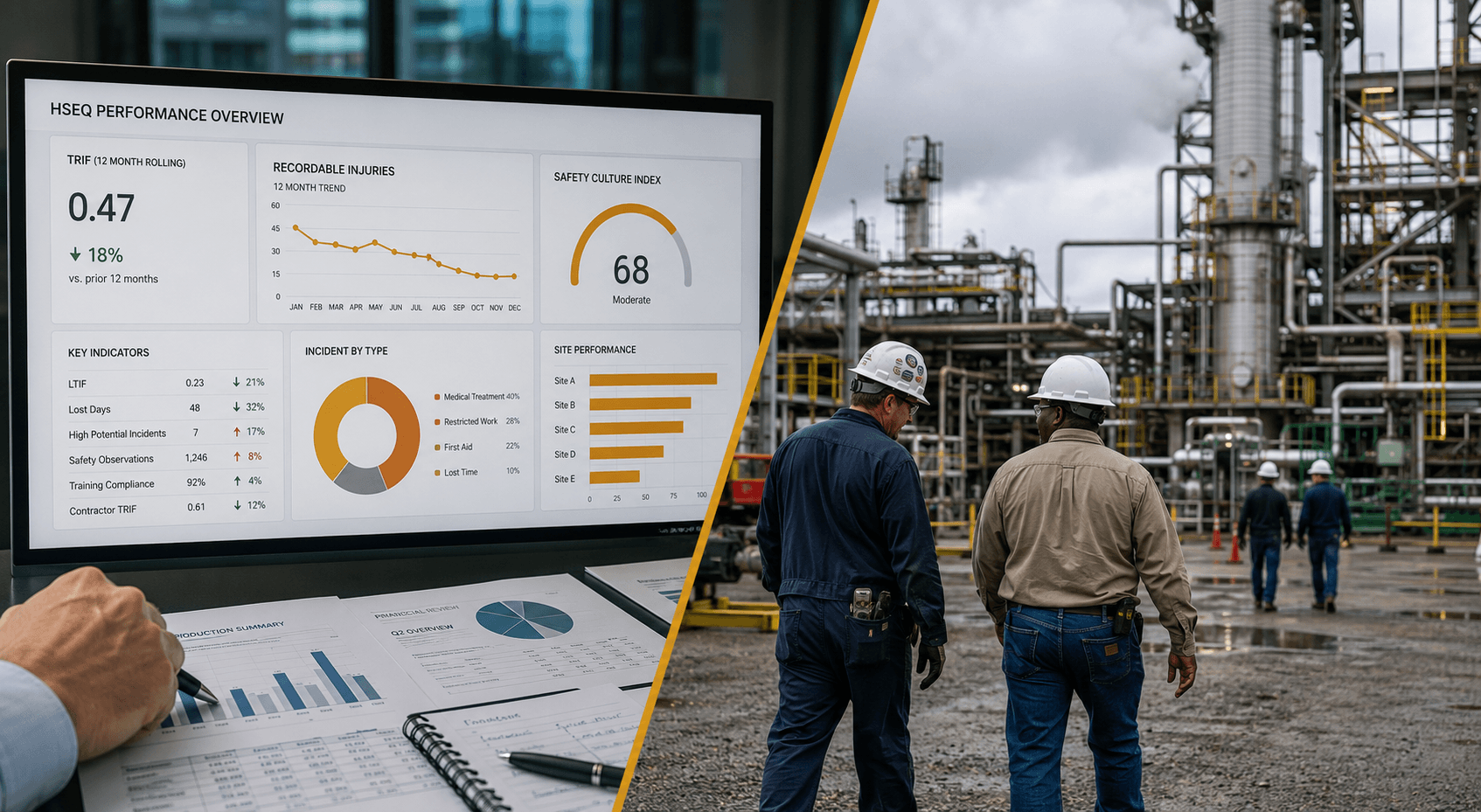
For decades, organizations have relied on Total Recordable Injury Frequency as the defining measure of safety performance.
It appears in annual reports, executive dashboards, board packs, investor presentations, contractor prequalification systems, and leadership updates. A low TRIF is often celebrated as evidence of operational excellence, strong leadership, and a healthy safety culture.
But there is a growing problem.
TRIF tells leadership and boards almost nothing about the actual health of the safety system.
In many organizations, TRIF has become a comfort metric — a number that creates the illusion of control while obscuring the presence of critical risk. Boards are being reassured by declining injury statistics while catastrophic exposures remain unmanaged. Leadership teams are congratulating themselves on “good safety performance” while serious system weaknesses sit beneath the surface.
The uncomfortable reality is this: organizations can achieve world-class TRIF rates and still kill people.
That is the illusion of safety. And it is dangerous.
For organizations where HSEQ, ESG, critical risk, operational performance, and enterprise value are closely connected, safety reporting cannot sit outside the operating model. It has to show leaders the real condition of exposure, control, resilience, and operational performance. Anything less creates comfort where there should be concern.
Why TRIF Became the Number Everyone Could Hide Behind
TRIF became powerful because it made safety simple.
It was easy to calculate, easy to benchmark, easy to trend over time, appealing to executives and regulators, and convenient for investor reporting.
Eventually, the number itself became the objective.
Instead of asking whether the organization had control over the risks that could seriously harm people, leaders began asking whether the TRIF rate was improving. Instead of asking where exposure was increasing, they asked whether the dashboard was green. Instead of asking whether critical controls would hold under pressure, they accepted a lag indicator as reassurance.
That is where the distortion began.
TRIF gave executives something to point to. It gave boards something to accept. It gave organizations something to celebrate. But it did not necessarily give anyone visibility into the risks that could cause a fatal event tomorrow.
A low TRIF can create the appearance of control without proving the presence of control. That is the problem.
Nearly 100-Year-Old Thinking Is Still Shaping Safety Dashboards
TRIF emerged from an era when workplace safety was largely focused on personal injury prevention. The underlying assumption was simple: if organizations reduced minor injuries, they would also reduce serious injuries and fatalities.
This thinking was heavily influenced by Heinrich’s accident triangle, first published in 1931. [1]
That was almost 100 years ago.
Yet much of modern safety reporting is still shaped by the same old logic: reduce the small events and the big events will take care of themselves.
High-consequence risk does not work that neatly.
Fatal and catastrophic events are not simply larger versions of minor injuries. They often emerge through different pathways: degraded controls, weak assurance, poor supervision, maintenance gaps, production pressure, contractor risk transfer, normalized deviation, and leadership blind spots.
A worker twisting an ankle while stepping off a curb contributes to TRIF. A technician working beneath a suspended load with failed controls may not. An office ergonomic strain can worsen the number. An uncontrolled energy isolation failure that nearly harms multiple workers may not affect it at all.
That is what old injury-frequency thinking misses. It assumes the small things explain the big things. In high-consequence environments, they often do not.
TRIF Measures Outcomes, Not Risk
TRIF measures recorded injury outcomes. It does not measure exposure to fatal or catastrophic risk.
That creates a profound mismatch between what boards think they are seeing and what actually threatens the organization.
TRIF answers one narrow question: how many recordable injuries occurred?
Leadership and boards need answers to entirely different questions. What critical risks could kill people tomorrow? Which controls are degraded or failing? Where is operational drift occurring? Are verification systems functioning? Are leaders receiving weak signals early enough? Which sites are normalizing deviation? What risks are increasing despite stable lag indicators?
TRIF provides almost no insight into these issues.
It does not tell a board whether critical controls are working. It does not tell an executive team where fatal exposure is increasing. It does not reveal whether production pressure is eroding safeguards. It does not show where supervisors are tolerating deviation or where workers no longer trust the reporting culture.
This is why TRIF becomes dangerous when it dominates the safety conversation. It can make leadership feel informed when they are not.
Low TRIF Often Creates False Confidence
One of the most dangerous aspects of TRIF is psychological.
When injury rates decline, leadership naturally assumes safety is improving. Boards see green dashboards. Investors see stability. Executives interpret the trend as evidence that systems are working.
But low injury frequency can coexist with poor critical control verification, weak supervision, production pressure, under-reporting, contractor risk transfer, normalized non-compliance, fatigue accumulation, degraded maintenance, and ineffective learning systems.
That is the danger. The organization looks safe statistically while becoming increasingly fragile operationally.
Some of the world’s worst industrial disasters occurred in organizations with strong personal injury statistics before the event. Deepwater Horizon [2] , the Texas City Refinery explosion [3] , and the Pike River Mine disaster [4] are often discussed in this context because they exposed the gap between visible safety performance and the true condition of critical risk controls.
In several cases, executives were proudly reporting declining injury rates shortly before catastrophic loss.
The problem was not the absence of data. The problem was measuring the wrong thing.

Green dashboards can hide the risks that matter most.
Boards need visibility into control, not another measure of reassurance. They need to know what could fail, what is being controlled, and where exposure is still being carried.
TRIF Drives Dysfunctional Behaviours
Metrics shape behaviour.
Once executive bonuses, contractor performance, leadership reviews, and board scrutiny become tied to TRIF, organizations inevitably begin managing the number rather than the risk.
This can produce predictable consequences:
- Injury classification disputes.
- Under-reporting.
- Pressure not to seek treatment.
- Administrative manipulation.
- Excessive focus on low-consequence hazards.
- Safety theatre.
- Blame-oriented investigations.
- Fear-based reporting cultures.
Workers quickly learn what leadership truly values.
If leaders obsess over injury numbers, the workforce hears: do not create recordables. Not: identify and manage critical risk.
That distinction matters enormously.
One protects the dashboard. The other protects people, assets, operations, reputation, and enterprise value.
The wrong metric quietly redirects attention away from what actually kills people. It can make an organization highly disciplined at reducing reported injuries while still weak at controlling fatal exposure.
That is not safety excellence. That is metric management.
Boards Need Exposure Intelligence, Not Injury Statistics
Modern boards operate in increasingly complex, high-risk environments. Their responsibility is governance of enterprise risk, not simply injury counting.
A board that receives only TRIF data is effectively blind to operational reality.
Boards should be asking for exposure intelligence. That means visibility into critical risk exposure, control effectiveness, verification quality, learning system maturity, capacity pressures, operational drift, leadership field engagement, serious injury and fatality precursor events, high-potential incidents, system resilience, and weak signal detection.
The question should never be: how many injuries did we record?
The question should be: how confident are we that our critical controls would prevent a fatal event today?
That is a fundamentally different governance conversation.
It shifts safety reporting away from injury statistics and toward operational truth. It forces leadership to examine where confidence is earned, where it is assumed, and where the organization may still be relying on luck.
Boards do not need another number that reassures them. They need to know what could fail, what is being controlled, and where exposure is still being carried.
The Shift Toward Critical Risk Thinking
Leading organizations are moving away from injury frequency obsession and toward critical risk management.
This shift recognizes several realities. Fatalities are not simply “large minor injuries.” Serious events emerge from complex system interactions. Low-frequency, high-consequence risks require different controls. Learning matters more than counting. Exposure and control verification are more predictive than lag indicators.
As a result, mature organizations are increasingly measuring critical control health, verification quality, exposure frequency, high-potential events, barrier integrity, learning effectiveness, organizational capacity, safety culture indicators, operational discipline, and system resilience.
TRIF may still exist as a regulatory, historical, or benchmarking metric. But it should no longer be treated as the primary indicator of safety health.
A low TRIF is not evidence of safety excellence. At best, it is evidence of low recorded injury frequency. Those are not the same thing.
This is where a structured enterprise model, such as the Ventari Summit™ Framework, can help organizations connect critical risk, control health, assurance, operational performance, and leadership decision-making.
What Leadership Should Ask Instead
If leadership and boards genuinely want visibility into safety performance, they need to ask sharper questions.
- What are our top fatality risks?
- Which controls are most vulnerable today?
- Where are we operating outside design intent?
- What risks are increasing operationally?
- What are we learning from weak signals?
- How do we know our controls actually work?
- Where is production pressure eroding safeguards?
- What concerns are frontline workers hesitant to raise?
- Which sites worry operational leaders most, and why?
- Most importantly, what could kill someone here despite a low TRIF?
These questions produce insight. TRIF rarely does.
TRIF Is Not the Future
TRIF survived because it is simple, familiar, and easy to communicate. But simplicity is not the same as usefulness.
For modern organizations, especially those managing high-consequence risk, TRIF is an increasingly inadequate measure of safety health. It captures outcomes that are often disconnected from catastrophic exposure, reinforces dysfunctional behaviours, and provides boards with false assurance.
Leadership teams should stop confusing injury frequency with risk control. Boards should stop accepting green dashboards as evidence of operational integrity.
TRIF is not safety. It is not control. It is not proof that people are protected.
The future of safety leadership lies not in counting injuries but in understanding risk, resilience, exposure, and control effectiveness. That is where meaningful governance begins.
Good Reporting Should Create Informed Unease
Strong safety governance reporting is predictive rather than historical, exposure-focused rather than injury-focused, control-based rather than compliance-based, narrative-rich rather than dashboard-heavy, operational rather than bureaucratic, and concern-oriented rather than reputation-oriented.
Good reporting should create informed unease.
If every board safety report is green, simplified, and reassuring, the board is probably not seeing reality. It may only be seeing the part of the system that is easiest to count.
Safety reporting should not exist to comfort leadership. It should help leadership see what requires attention before harm occurs. It should reveal where controls are holding, where they are degrading, and where operational pressure is creating exposure.
A clean dashboard is not the same as a controlled operation. The absence of recorded injuries does not mean the presence of safety.
Move Beyond the Illusion of Safety
Ventari Global helps organizations move beyond comfort metrics and build stronger visibility into HSEQ, ESG, assurance, critical risk, operational performance, and enterprise control.
If your organization is still relying on TRIF as the primary signal of safety health, it may be time to ask the harder question: What could kill someone here despite a green dashboard?
References
- SKYbrary, Heinrich Pyramid, June 26, 2022.
- U.S. Coast Guard, Deepwater Horizon, April 12, 2016.
- U.S. Chemical Safety Board, BP America Texas City Refinery Explosion, March 20, 2007.
- Royal Commission on the Pike River Coal Mine Tragedy, Final Report, October 30, 2012.
Stop Managing Safety With 100-Year-Old Logic
Instead of relying on outdated injury-frequency metrics to reassure leadership, build visibility into the exposures, controls, and weak signals that show where serious risk is actually building.