Organizational Stability Is Becoming a Premium Capability
As volatility, complexity, and operational pressure increase, stability is becoming one of the clearest indicators of enterprise quality. Mature systems help organizations maintain continuity, protect value, and execute with confidence through disruption.

For much of the modern business era, organizations viewed growth, speed, and expansion as the primary indicators of organizational strength.
Today, however, a different capability is emerging as a defining characteristic of high-performing enterprises: stability.
This does not mean stagnation, bureaucracy, or resistance to change.
Instead, stability is the ability to maintain control, consistency, and reliable execution in environments defined by volatility, complexity, and accelerating operational pressure.
Across industries, organizations face geopolitical instability, workforce disruption, supply chain fragility, regulatory expansion, reputational exposure, technological acceleration, contractor complexity, and rising stakeholder expectations.
As a result, instability compounds quickly.
Minor operational weaknesses can rapidly escalate into strategic, financial, or reputational consequences when organizations lack the governance systems and operational discipline needed to absorb disruption effectively.
Consequently, sophisticated organizations are changing how they think about performance.
Why Stability Matters More Under Pressure
Leaders are shifting the conversation away from short-term optimization and toward sustainable operational resilience.
Increasingly, they recognize stability as a premium organizational capability because it supports predictable execution, stronger governance, operational continuity, and strategic agility in more demanding conditions.
Importantly, stability does not reduce performance.
In fact, it enables it.
A stable organization is not one that avoids growth, risk, or complexity. Rather, it can keep operating with clarity when those pressures increase.
That distinction matters in complex and high-risk environments, where disruption rarely stays isolated. For example, a small gap in execution can affect safety, assurance, workforce confidence, regulatory exposure, stakeholder trust, or operational continuity.
What Stability Means to Boards and Investors
For boards and investors, stability is becoming a stronger signal of enterprise quality.
It shows whether the organization can sustain performance without depending on constant intervention, informal workarounds, or reactive leadership.
This matters during periods of expansion, acquisition, transformation, restructuring, or market uncertainty.
Consequently, organizations with stable operating conditions give boards and investors greater confidence that the enterprise can maintain continuity, govern risk, protect value, and respond to disruption without losing control of execution.
In this sense, stability is not just an operational outcome.
It is also a confidence signal.
Boards look for evidence that leadership can see where risk is building. Meanwhile, investors seek evidence that the organization can sustain performance, and operators need systems that help teams execute consistently when pressure increases.
Together, stability connects all three.
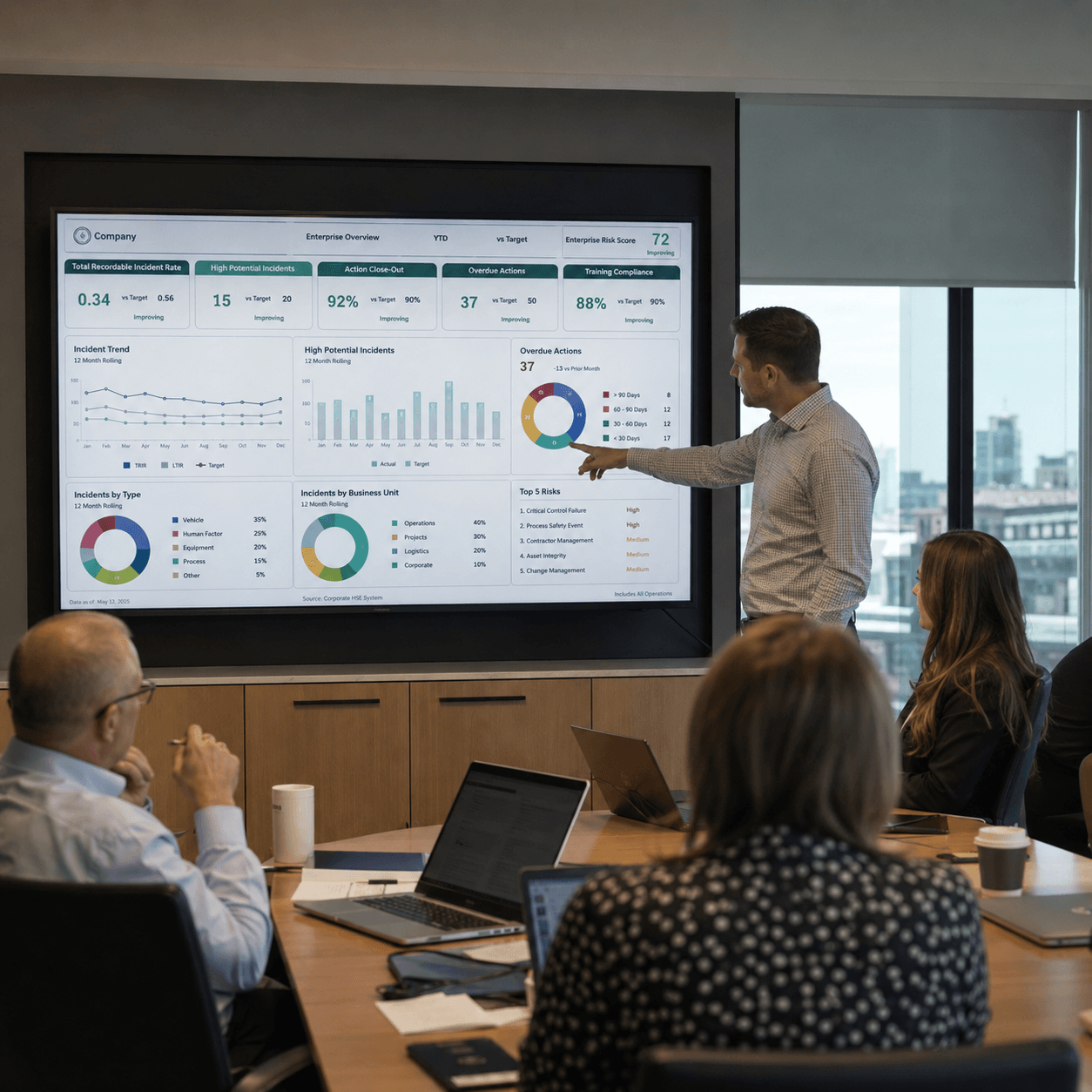
Stability is not the opposite of growth. It is what allows growth to hold.
When the environment becomes unpredictable, the strongest organizations do not just react faster. They stay coordinated, make cleaner decisions, and keep momentum from breaking down.
Why High-Risk Environments Expose Instability Faster
In high-risk operating environments, instability becomes visible faster because weak systems create more serious consequences.
Fragmented governance, inconsistent execution, weak assurance mechanisms, unclear accountabilities, and poor escalation pathways can create systemic vulnerabilities across the enterprise.
- Contractor issues can become safety issues.
- Reporting gaps can become assurance issues.
- Inconsistent leadership can create cultural issues.
- Process failures can become reputational issues.
- Weak control environments can create financial issues.
This is why organizational stability is especially important in sectors where operational failure can create material consequences for people, assets, regulators, investors, and communities.
Therefore, organizations with mature HSEQ management systems, integrated governance structures, disciplined operational frameworks, and strong leadership alignment can scale more sustainably, respond to disruption, and protect enterprise value during periods of uncertainty.
The Cost of Instability
Ambition alone does not build the strongest enterprises.
Control architecture does.
Meanwhile, stakeholders are paying closer attention to organizational resilience, operational maturity, assurance capability, and leadership discipline as indicators of long-term sustainability.
Organizations that cannot maintain stability under pressure eventually lose strategic flexibility.
- Operational drift begins to erode performance.
- Governance gaps weaken visibility.
- Leadership becomes reactive.
- Execution quality deteriorates.
- Risk exposure increases.
Over time, instability becomes expensive.
It consumes leadership attention, slows decision-making, weakens confidence, and reduces the organization’s ability to move from a position of strength.
Therefore, stability is becoming more than a defensive capability. It is becoming part of how organizations protect performance, preserve value, and maintain strategic flexibility under pressure.
The Role of HSEQ in Organizational Stability
HSEQ plays a direct role in organizational stability because it sits close to the operating conditions that determine whether teams perform work safely, consistently, and reliably.
In mature organizations, leaders do not treat HSEQ only as a compliance function. Instead, they use it to understand operational health.
Specifically, HSEQ systems can show whether controls are working, assurance activities are effective, corrective actions are closing, incidents are isolated or systemic, and teams are translating leadership expectations into consistent execution.
This matters because instability often develops before it becomes visible at the financial level.
By the time disruption appears in financial performance, the underlying operational signals may have existed for some time.
Therefore, mature HSEQ systems help organizations see those signals earlier and respond with greater discipline.
Growth creates momentum. Stability determines whether an organization can sustain it.
Stability as a Strategic Differentiator
Looking ahead, stability will likely become one of the clearest differentiators between organizations that merely grow and those capable of enduring sustained complexity at scale.
Growth creates momentum.
Stability determines whether an organization can sustain that momentum.
In an increasingly unpredictable environment, stability is no longer defensive.
Instead, it is a strategic capability.
At Ventari Global, this is the work: helping organizations understand whether clarity, continuity, and execution quality can hold when operating conditions become more demanding.
Easy conditions do not prove stability.
Rather, disruption proves it by testing the organization’s ability to govern clearly, respond consistently, and keep performance from deteriorating.
To strengthen that capability, explore how Ventari Global helps leaders evaluate operating maturity, close critical gaps, and strengthen reliability in periods of disruption.
Strengthen the Maturity Behind Reliable Performance
Identify the systems, gaps, and operating conditions that determine whether performance can hold as complexity intensifies.
View Our Services